
API First Development: Practical Guide for Teams
Discover how API first development improves collaboration, speed, and scalability. A practical guide for engineering teams in 2026.

API-first isn’t just a cleaner way to write software, it’s how a lot of teams now ship the product itself. In Postman’s 2025 State of the API Report, 82% of organizations had adopted some level of API-first, and 25% were fully API-first (Postman 2025 report). That’s the part many teams miss when they still talk about APIs like an implementation detail, because the methodology has crossed into an operating model with owners, contracts, and revenue attached.
Table of Contents
- Why API First Development Is No Longer Optional
- The Contract-First Core Idea
- Design-First vs Code-First, Side by Side
- Governance, Versioning, and the CI Pipeline
- Measuring Whether API-First Actually Pays Off
- Documentation as Part of the Contract
- Pitfalls, Migration Patterns, and How to Start Small
- A 30-Day Plan for Adopting API-First
Why API First Development Is No Longer Optional
The mistake is treating API-first as the same thing as “we have an API.” Those are different maturity levels. One is a contract-centered operating model, the other is just a surface area decision, and the market has clearly moved toward the first.
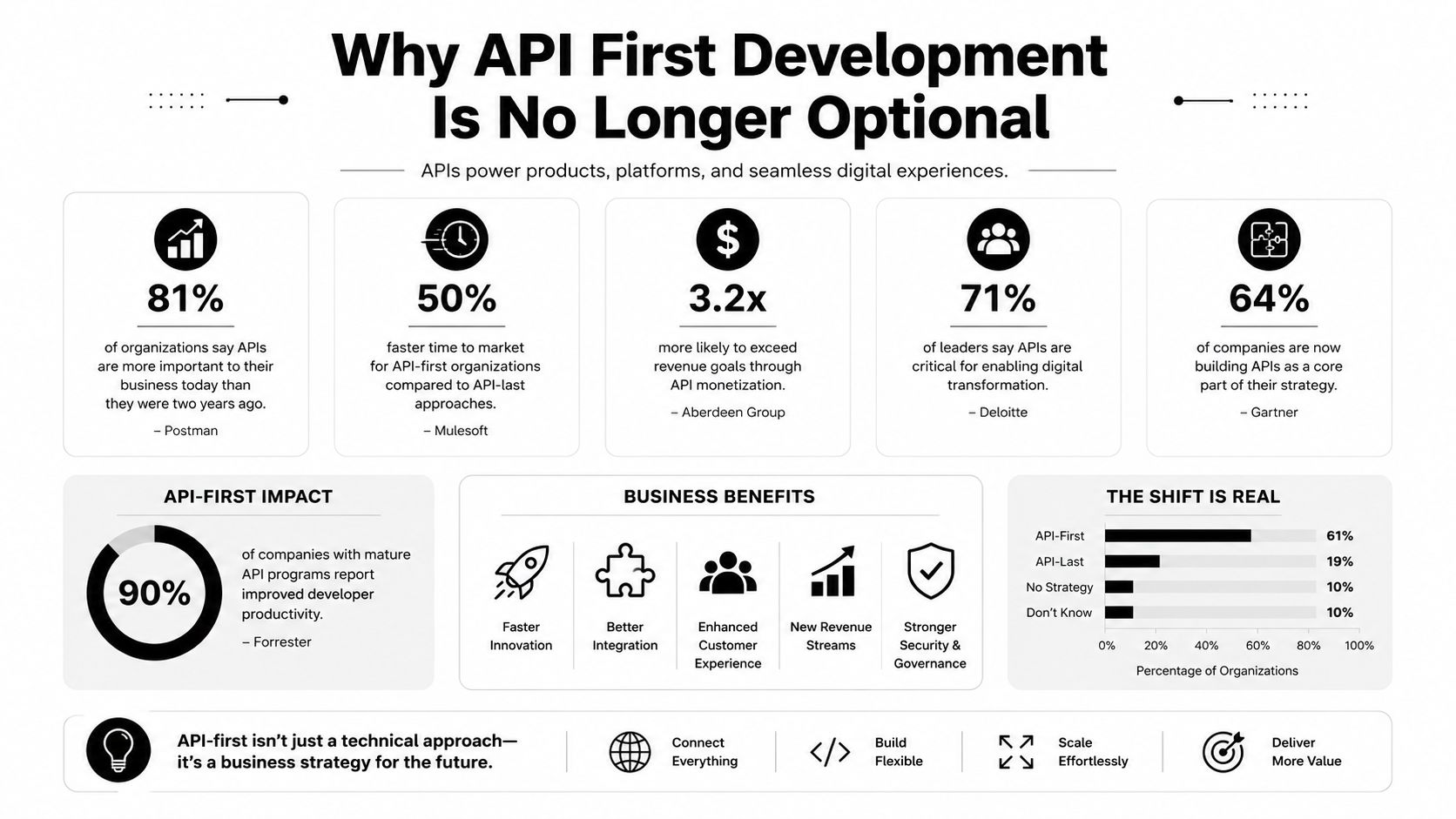
Postman’s 2025 State of the API Report says 82% of organizations now follow some level of API-first, and 25% are fully API-first. That matters because it shows the approach is no longer a niche discipline for platform teams. It is becoming the default way larger software organizations coordinate product, backend, frontend, and integrations. Postman also reported that 65% of organizations now generate revenue from their APIs, and among fully API-first organizations, 43% generate more than a quarter of total revenue from APIs.
What changes when the API is the product boundary
When teams still treat the API as a side effect, they usually discover contract issues late. Frontend teams wait on backend endpoints, partner integrations get blocked, and doc pages drift away from what ships. API-first changes the order of work so that the public interface becomes the thing people agree on first, then implement.
The shift is organizational. Product managers can shape the surface area earlier, engineering leads can reduce integration surprises, and DevRel or platform teams can publish a more stable story to consumers. That is why API-first has value beyond engineering speed. It creates a shared artifact that other teams can build around, review against, and govern with less ambiguity.
A good way to frame it is simple, if the API is what your product exposes to customers, partners, or internal consumers, then the contract is part of the product. The rest of the code follows that decision. The GitDocAI resource on API and microservices is useful here because architecture and ownership get harder to keep aligned once the interface spans multiple repositories and services.
When the API is the product boundary, governance and documentation become part of the product itself, not afterthoughts tacked on later.
Practical rule: if a consumer can build against your API before your service is finished, you are operating API-first. If they cannot, you are probably still code-first with better branding.
The Contract-First Core Idea
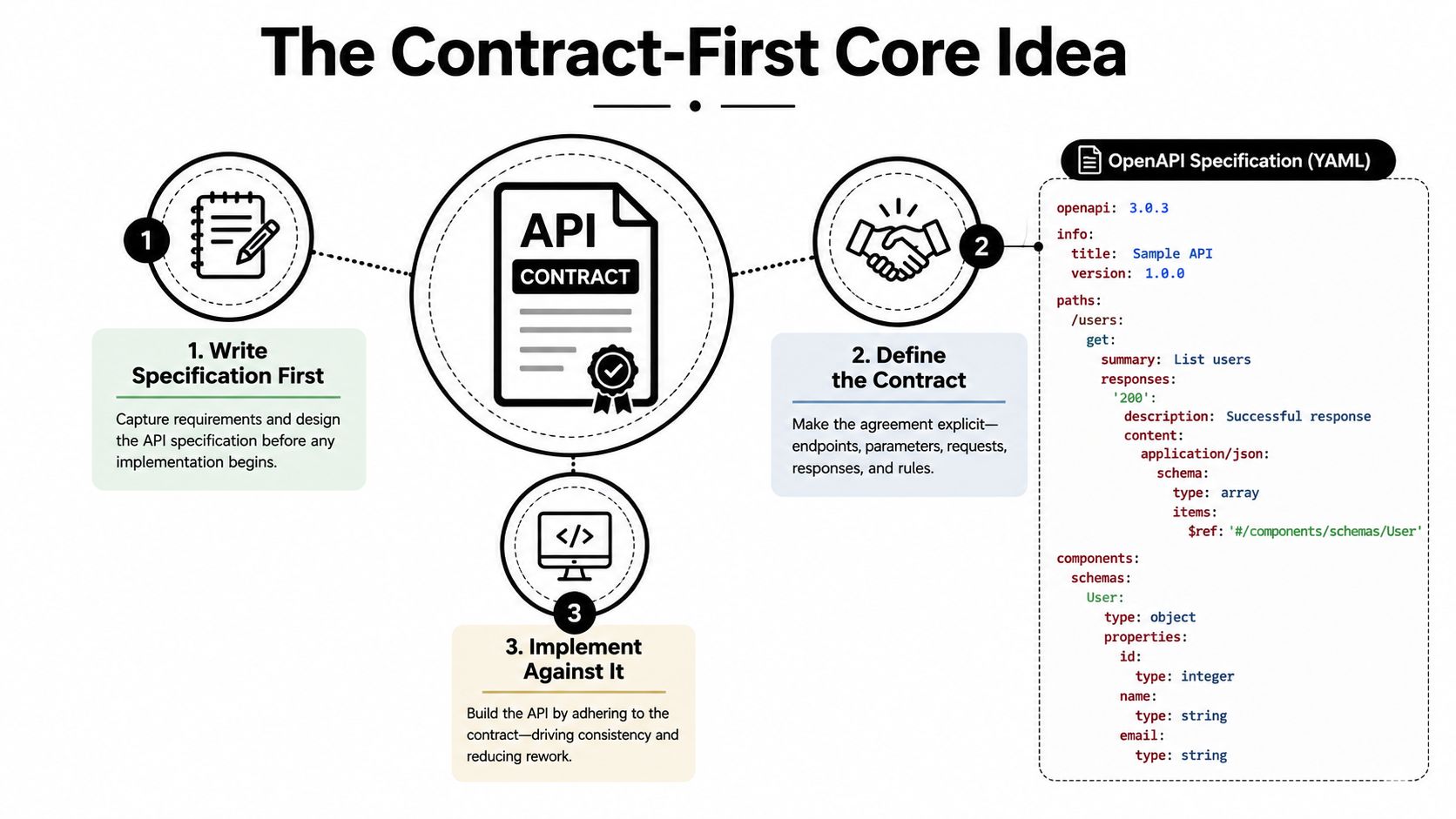
API-first starts with one hard rule, the specification is the contract, and it comes before implementation. That sounds simple, but it changes how teams work every day, because the spec stops being a documentation artifact and becomes the source of truth for code generation, mocks, tests, and review.
What lives in the spec
An OpenAPI file describes paths, parameters, request bodies, response shapes, and error conditions. In practice, that means a backend engineer and a technical writer are both looking at the same structure, not two separate versions of the truth. A minimal pattern looks like the OpenAPI example in the earlier research brief, where a single Order schema is defined once and reused across responses, which keeps the contract DRY and consistent.
From that same file, teams can generate mocks, SDKs, server stubs, and smoke tests. That’s the part that makes the contract useful before code exists. Frontend teams can point at a mock server and move in parallel while backend engineers implement the service against the same agreed schema.
How contract drift gets caught
The strongest version of contract-first development adds automation to the pipeline. Define the contract in OpenAPI or AsyncAPI, generate artifacts from it, then fail the build when implementation drifts from the spec. That catches changes like renamed fields, missing status codes, or undocumented response shapes before a release reaches consumers.
This is also where event-driven systems fit cleanly. For async surfaces, AsyncAPI plays the same role that OpenAPI plays for HTTP. The idea is still the same, publish the contract first, then implement against it.
The contract isn’t a comment on the codebase. It’s the interface everyone else depends on.
Design-First vs Code-First, Side by Side
Teams usually end up on one of two paths. Design-first means the OpenAPI spec gets written, reviewed, and agreed before implementation. Code-first means the framework generates the spec after the code already exists. Both can work, but they optimize for different kinds of teams.
| Dimension | Design-First | Code-First |
|---|---|---|
| Speed of initial delivery | Slower at the start, because the contract needs review | Faster to get something running |
| Catching contract drift | Strong, especially with linting and contract tests | Weaker unless extra controls are added |
| Cross-team coordination | Better fit for many consumers and reviewers | Better for a small team moving fast |
| Learning curve | Higher, because the team must think in contract terms | Lower, because it follows framework habits |
| AI and SDK generation | Strong fit, because the spec is the source of truth | Possible, but usually downstream of implementation |
If you need a neutral primer on deciding what kind of API surface you have, the ThirstySprout overview of API selection is a helpful reference point for distinguishing interface choices from broader operating models.
When each approach wins
Design-first usually wins for public APIs, platform surfaces, and partner integrations, because review and predictability matter more than raw starting speed. Code-first can be the right call for fast-moving internal services where the consumer is the same team and the risk of drift is lower.
The common mistake is to treat code-first as harmless because it feels productive early. It is productive early, but it often pushes integration pain, review gaps, and SDK churn into the future. That’s fine for a short-lived internal service, less fine for a surface other teams or customers will depend on.
Governance, Versioning, and the CI Pipeline
The hard part starts after the spec is written. Governance is what keeps API-first from becoming a one-time design exercise with no operational memory. Without it, every team drifts toward its own naming, versioning, and deprecation habits, and the contract stops being contract-like.
What the operating model needs
Start with a clear ownership model. A platform team, API council, or DevRel function can act as the contract steward, but someone has to review changes, maintain style rules, and handle breaking decisions. That same owner should control the rules for versioning, deprecation windows, and how consumers are told that a surface is changing.
The workflow is straightforward when it’s real. A spec change enters review. A breaking-change committee or designated approver checks whether the update needs a major, minor, or patch path. Contract tests run in CI, so tools like Pact, Spectral, and schemathesis can block merges or deployments when the implementation no longer matches the spec. That’s how a bad change gets caught before customers do.
The documentation and sunset side
Versioning isn’t just about tags in a path. It also includes deprecation messaging, sunset headers, and the discipline to update docs when a version changes. If teams don’t budget for retirement work, old versions linger forever and the backlog becomes a product liability.
For a deeper view of versioning choices and documentation alignment, the GitDocAI resource on API documentation versioning is a useful companion when the surface starts supporting multiple versions at once.
A good CI pipeline makes the contract visible at every stage. The spec is checked, the build fails on drift, and the release only proceeds when the implementation, versioning rule, and docs all agree.
Practical rule: if a breaking change can reach production without a failed contract test, your governance is ceremonial, not operational.
A useful CI/CD reference for the broader release pipeline is the Rite NRG guide to CI/CD, especially if your team is still wiring API checks into a wider deployment flow.
Here’s a short example of how the review path and release path should separate:
- Spec change submitted, the change is reviewed as an API decision, not as a code cleanup.
- Contract validated in CI, linting and schema checks catch structural mistakes.
- Version decision recorded, the team chooses whether the change is compatible or breaking.
- Release gated, the pipeline fails if implementation and contract disagree.
- Docs and sunset notes updated, consumers see the same story the code now tells.
Measuring Whether API-First Actually Pays Off
API-first pays off only when it changes how teams ship, support, and govern interfaces. If leaders treat it as a design preference, the value gets fuzzy fast. The better question is whether it shortens delivery, reduces contract drift, and produces revenue or consumer value that justifies the operating overhead.
Revenue tells part of the story
External API programs can become a real line of business, but that only happens when the organization treats the API as a product surface with ownership, support, and clear usage rules. Postman’s 2025 State of the API Report points to that shift in the market, and the broader lesson is simple, API-first often ends up tied to commercial outcomes, not just engineering discipline.
That matters because it changes the conversation inside the company. Once product leaders see the API as something that can carry revenue, governance and documentation stop being side work. The operating model starts to look different, too, because teams have to account for versioning, consumer impact, and support burden instead of only release speed.
The internal metrics that matter
A CTO or VP Engineering should track four things:
- Lead time for API changes, from approved spec change to deployed release.
- Contract-drift incidents, meaning the number of times implementation no longer matches the spec.
- Onboarding time for new SDK consumers, especially if the API ships client libraries.
- Doc freshness, meaning how quickly docs reflect the live contract after a change.
Those four signals tell you whether API-first is reducing friction or creating a new layer of process. If lead time improves but drift rises, the team is shipping faster at the expense of trust. If onboarding takes longer, or documentation lags behind the live contract, consumers pay the cost in support tickets and avoidable rework.
The other failure mode is governance without automation. Teams add review steps, but the spec, implementation, and docs still move independently. That is how API-first turns into another queue instead of an operating model. A healthier setup is one where contract checks, version rules, and docs updates are part of the same release path, with the GitDocAI guide on OpenAPI auto-generated docs staying in sync showing one practical way to keep the reference layer aligned.
If the contract reduces rework and keeps docs current, the program is earning its keep. If every release slows down and the spec still drifts from reality, the issue is not the idea of API-first, it is the way the team has implemented governance, review, and documentation.
Documentation as Part of the Contract
A lot of API-first programs stumble in documentation. The spec gets written, the service gets shipped, and the docs portal slowly turns into a museum of old examples and stale response shapes. The docs layer needs to be treated as part of the contract itself, integrated into the same workflow as the spec.
What auto-sync changes
One team I’ve worked with had a hand-written portal that lagged every release. Engineers would merge API changes on Tuesday, then writers would spend Friday reconstructing the new shapes from commit history and Slack threads. Once they moved to an OpenAPI-driven auto-sync workflow, every code change proposed a doc diff that reviewers could accept, reject, or edit inline.
That pattern is exactly what the GitDoc guide on keeping OpenAPI-generated docs in sync is meant to support. The contract stays in source control, the generated pages stay aligned, and the review happens where the change already lives. It also gives writers more room to focus on tutorials, conceptual guides, and onboarding paths instead of retyping reference pages that the spec already defines.
For teams comparing generated docs workflows, the RewriteBar on API documentation best practices is a useful practical resource on what good reference material still needs beyond the raw schema.
Why writers and AI both benefit
Generated docs reduce doc rot because the spec is the source of truth. They also make the docs easier for AI assistants and structured tool surfaces to consume, since the content is already machine-readable and attached to the contract. In a modern docs stack, that matters for developers and for agents that depend on accurate reference material.
The strongest workflow I’ve seen is straightforward. A pull request changes the API spec, the docs regenerate, and the resulting update appears as a reviewable change alongside the code. That keeps the team honest, because documentation cannot fall behind unless someone explicitly approves the gap. It also cuts down on contract drift, since the reference layer moves through the same checks as the implementation.
Pitfalls, Migration Patterns, and How to Start Small
API-first goes wrong in predictable ways. The biggest failure is a spec that nobody owns, nobody reviews, and nobody trusts. The second is trying to govern everything before a single consumer has felt the benefit.
Where teams get stuck
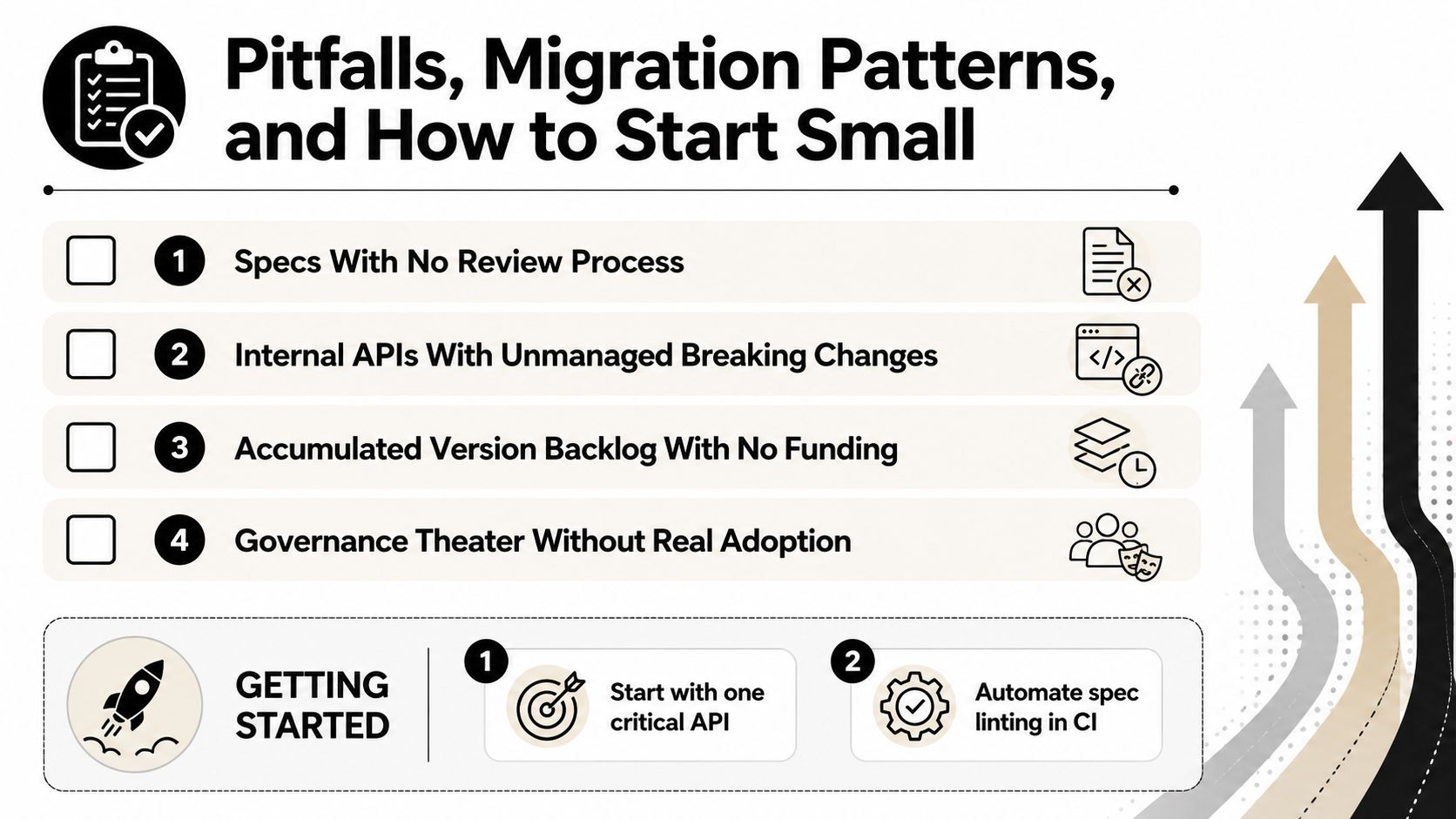
Some teams build internal-only APIs and assume they don’t need governance, then ship breaking changes anyway. Others create a version backlog and never fund cleanup, so old contracts pile up until nobody wants to touch them. Then there’s governance theater, where style guides exist but no release ever gets blocked when a contract breaks.
A more subtle mistake is adopting heavyweight tooling before the team has a contract worth governing. If you have one small service and one consumer, a full operating model can become overhead. API-first shines when there are multiple consumers, multiple surfaces, or clear product consequences if the contract shifts unexpectedly.
The migration path should be narrow at first. Pick one critical API, write the contract, generate the docs and SDKs, wire a single contract test into CI, and then expand only after the team feels the difference. That creates proof without forcing the whole platform to change on day one.
A small-start checklist
- Start with one surface, preferably the one most visible to consumers.
- Write the spec first, so reviewers can catch drift before implementation.
- Automate linting in CI, because manual contract review doesn’t scale.
- Sync docs from the same source, so the reference pages don’t fall behind.
For teams that want the docs side to keep up while the API changes, auto-sync platforms like GitDocAI can keep the documentation repo aligned with the code repo instead of turning updates into a separate project.
A 30-Day Plan for Adopting API-First
| Days | Focus | Outcome |
|---|---|---|
| 1 to 7 | Pick one API surface and name an owner | The team has a single contract to govern |
| 8 to 14 | Write the OpenAPI spec and review it with consumers | The interface is explicit before code lands |
| 15 to 21 | Generate mocks, SDKs, and docs from the spec | Frontend and integrators can move in parallel |
| 22 to 26 | Add one contract test to CI | Drift gets blocked before release |
| 27 to 30 | Connect auto-synced docs to the same repo | The published reference stays in step with the code |
The first month isn’t about perfect governance, it’s about proving the operating model works on one surface. If the spec helps teams move faster and the docs stay current, expand it carefully to the next API. If it creates friction without payoff, tighten the workflow before broadening it.
GitDocAI helps teams keep API docs and generated reference material tied to the same source of truth as the code, which is exactly where api first development breaks down when docs are maintained separately. If you’re trying to turn contracts into living documentation instead of stale portals, visit GitDocAI and see how an auto-sync workflow fits into your release process.