
API Versioning Best Practices: A 2026 Guide
Learn API versioning best practices for URL, header, and media-type schemes, plus breaking changes, deprecation policies, and docs.

A common impulse is to reach for a version number too quickly. The core problem is rarely “how do we version this API,” but rather “how do we keep change moving without creating a permanent documentation and governance mess.” The best api versioning best practices start with restraint, because every new version adds migration work, support burden, and doc maintenance that won’t disappear on its own.
A 2024 large-scale study backs up how dominant metadata-driven versioning already is, with 98% of APIs using metadata-based versioning and dynamic versioning appearing in only 1,088 APIs across the datasets, plus more than 90% of artifacts using metadata-based versioning (study PDF). Another empirical study across 7,114 APIs found that 4,445 APIs (62.5%) and 102,986 commits (55%) put version identifiers only in info.version, and only 76 APIs were completely versioned in the researchers’ sense (study PDF). That pattern matters because versioning is usually treated as part of the contract, not a runtime discovery trick.
Table of Contents
- Why Most Teams Version Too Early
- Comparing the Four Main Versioning Schemes
- Breaking vs Non-Breaking Changes Explained
- Deprecation Policies and Sunset Windows
- Keeping Documentation in Sync Across Versions
- Testing and CI Practices for Versioned APIs
- Your API Versioning Checklist and Migration Playbook
Why Most Teams Version Too Early
Versioning should be a governance decision, not a reflex. Versioning mistakes often come from misclassifying a change. If a change does not force client code to change, it usually does not justify a new public version, even if it feels safer to ship it that way. Additive changes, like new optional fields, new endpoints, or new optional query parameters, belong in the current version when they stay backward compatible. Real breakage belongs in a new major version.
Ask whether the client actually breaks
A useful filter is simple. If a client can ignore the change and keep working, you probably do not need a visible version bump. Stable resource shapes, contract tests, and deprecation headers can carry a lot of evolution without forcing consumers into a new URL or header contract.
Practical rule: version the API when a client must change code, not when the server team wants a cleaner internal model.
That sounds obvious, but teams often version early because they are trying to reduce anxiety, not because they are solving a true compatibility problem. A version number can feel like safety, yet it also creates a second product to maintain, document, test, and retire. The best teams keep the surface stable and let the implementation evolve underneath.
Treat long-lived APIs as a real design option
“Versionless” does not mean reckless. It means choosing compatibility-first design, where changes are absorbed through additive evolution, explicit deprecation signals, and disciplined client behavior. Google’s guidance separates format versioning from entity versioning and recommends different signaling mechanisms for each, which is a useful reminder that “versioning” is not one thing (Google API design guidance).
That distinction matters in production. If you can preserve resource shape, keep field meanings stable, and use contract tests to guard behavior, you can often avoid visible version churn entirely. You still need a policy, though, because without one, every team will invent its own threshold for calling something breaking.
The question to ask in design review is blunt. Does this change force a consumer rewrite? If the answer is no, keep the current version and document the addition clearly. If the answer is yes, move to a deliberate major version decision, not a hidden surprise in a release note.
Comparing the Four Main Versioning Schemes
The scheme you choose affects more than routing. It changes discoverability, caching, documentation overhead, and how easily clients can reason about what they’re calling. In practice, the right choice depends less on ideology and more on who consumes the API, what infrastructure sits in front of it, and how much doc tooling you’re willing to maintain.
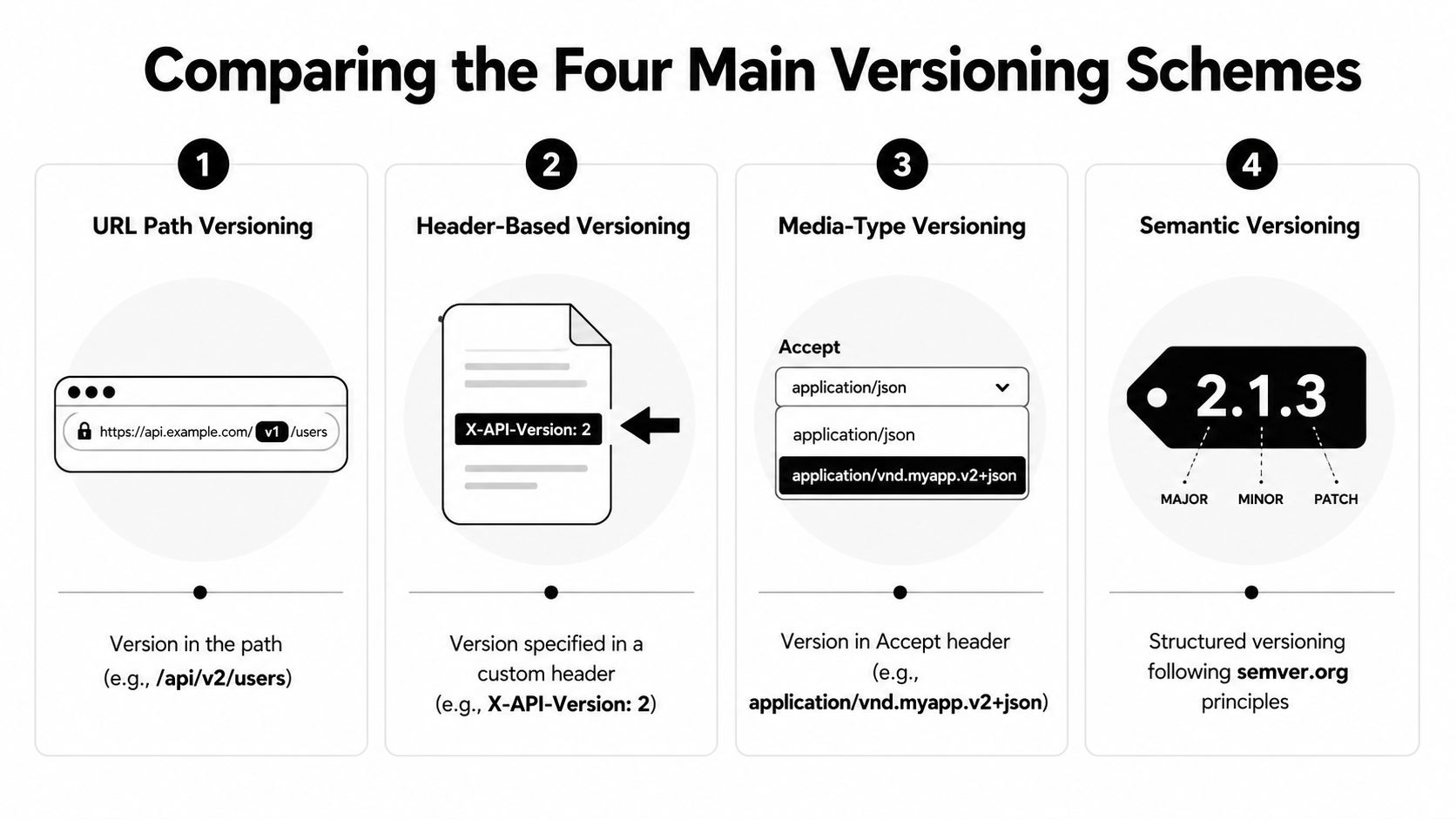
The four schemes side by side
| Scheme | Discoverability | Caching | Doc Complexity | Best For |
|---|---|---|---|---|
| URL path versioning | High | Friendly | Lower | Public APIs, simple client onboarding |
| Header-based versioning | Lower | Can be tricky | Higher | Clean URLs, controlled clients |
| Media-type versioning | Lower | Content negotiation dependent | Higher | Mature REST programs, careful contract control |
| Semantic versioning | Human-friendly | Neutral | Medium | Teams that need explicit release signaling |
URL path versioning is the easiest for clients to see and share. A request like GET /api/v2/users is obvious, easy to debug, and friendly to browsers, proxies, and CDNs. The trade-off is that URL sprawl is real, and every new major version creates another public path to document and support.
Header-based versioning keeps the path clean, for example X-API-Version: 2. It works well when your consumer base is disciplined and your tooling can handle header-based routing, but it’s less discoverable and often harder for external developers to test by hand. Media-type versioning pushes version selection into content negotiation, such as Accept: application/vnd.myapp.v2+json, which fits teams that already think about representation semantics.
Semantic versioning helps with release communication, but it doesn’t solve transport-level negotiation by itself. It’s a release language as much as a routing language, which is why many teams use it alongside another scheme instead of treating it as the whole strategy.
For a practical overview of rollout planning, the migration tactics for API releases resource is useful because it focuses on transitions, not just naming conventions. The big decision is whether you want maximum visibility, maximum protocol purity, or the least documentation friction.
Clean URLs help onboarding. Clean governance helps survival.
Breaking vs Non-Breaking Changes Explained
Most versioning mistakes start with the wrong label. A team calls a change “breaking” because it feels risky, then forks a version they did not need. Or they call something “safe” because it looks additive on paper, then ship a behavior shift that surprises clients in production.
The changes that usually stay in place
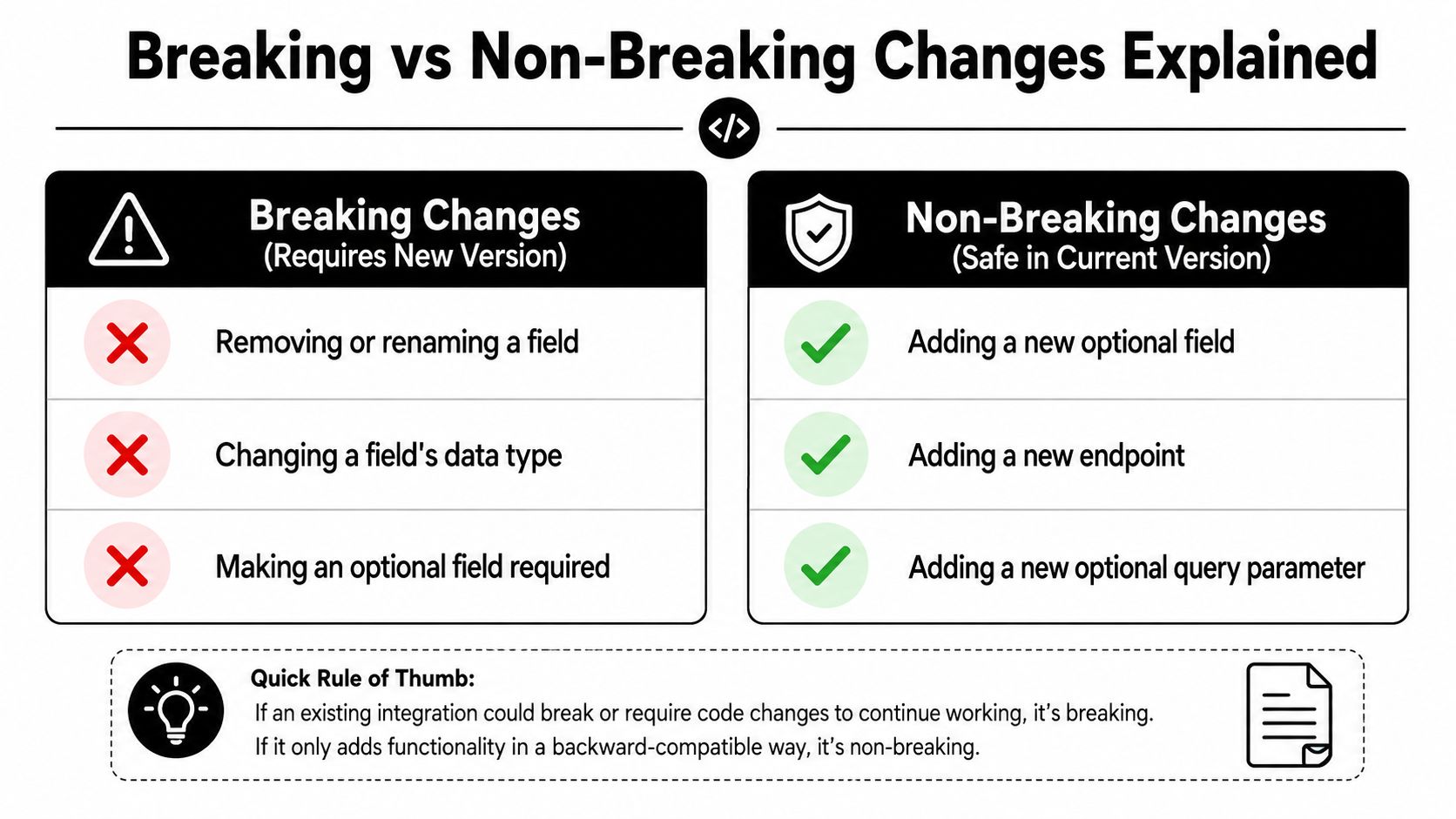
Additive changes are usually safe when existing clients can ignore them without changing behavior. A new optional field, a new endpoint, or a new optional query parameter normally fits that pattern. If an older client can still read the response and keep its meaning intact, there is no reason to force a version bump.
The risk is in behavior, not syntax. Tightening validation, shifting a pagination default, changing auth flow, or altering response semantics can be breaking even when the request and response shapes look familiar. Clients do not always fail loudly. Sometimes they keep running and just start doing the wrong thing.
The changes that should trigger a new version
Renaming or removing fields, changing data types, making an optional field required, and changing validation rules are the obvious breaking cases. Changes to auth flows or response semantics belong in the same bucket because clients often hard-code those assumptions into SDKs, middleware, and downstream jobs.
Checklist for version review: if a change alters required client code, invalidates stored assumptions, or changes the meaning of a previously valid response, treat it as breaking.
Borderline cases need tighter governance than the code review alone can provide. Pagination defaults are a classic trap, because the response schema may stay the same while the data a client sees changes. Rate-limit changes can cause the same problem. A stricter limit does not change the contract shape, but it can change practical reliability, so it still needs communication even when it does not force a major version.
Classification also belongs in the documentation workflow, not just the release meeting. If your OpenAPI notes and changelog rules are not consistent, the team will relitigate the same decision every time a client pushes back. A clear OpenAPI governance and linting workflow helps keep those calls consistent across versions, especially when parallel docs start to drift.
SemDash’s latest feature updates are a useful reminder that even routine releases can touch a lot of surface area as product behavior changes. API teams need the same discipline. Classify the change precisely, write down why it was treated as breaking or non-breaking, and keep that rationale visible so the next reviewer does not have to guess.
If the team cannot explain the classification in one sentence, the policy is too loose. Tighten the rule before the next release.
Deprecation Policies and Sunset Windows
A versioning policy without a retirement policy creates permanent sprawl. Mature API programs publish deprecation and sunset windows before clients feel pressure, keep overlapping versions available during migration, and make removals feel procedural instead of hostile. That approach cuts down emergency migrations and gives enterprise consumers time to line up release cycles across several teams. It also forces the harder governance work, because every live version carries documentation, support, and approval debt that has to be managed on purpose.
Build the sunset before you announce the version
A deprecation policy should define the warning period, the migration window, and the removal date before the first announcement goes out. The timing has to match the product and the audience. General APIs often need a long runway, paid APIs usually need a clearer contract around notice and support, and free APIs can sometimes move faster if the change is narrow and the client base is lighter. Those timelines are not magical, but they need to be long enough to avoid surprise and short enough to keep maintenance from turning into indefinite overlap.
The mechanics matter just as much as the dates. Publish deprecation and sunset signals in headers, keep changelogs current, and make the migration path easy to find from every versioned reference page. If the docs for v1 and v2 disagree, clients will assume the runtime is unstable even when the implementation is fine.
Use usage data to decide when a version can die
Sunsetting should follow observed consumption, not optimism. Track which version each client is using, watch for traffic decay, and check whether support channels are still seeing active integrations before you retire anything. In enterprise environments, one product team may be ready to upgrade while another is locked into a frozen release train, so the governance process needs named owners and a clear escalation path, not just a date in a calendar.
A useful internal template has three parts:
- Announcement: what changed, what stays supported, and where the migration guide lives.
- Support window: what bugs will still be fixed, what will not, and which version remains preferred.
- Removal notice: the exact endpoint or version that will be retired, plus the final migration date.
That structure keeps the message predictable, and predictability is what clients remember when a migration is disruptive. Strong migration guides help too, especially when teams need a clear path from old behavior to new behavior, as laid out in writing migration guides that users can actually follow.
Keeping Documentation in Sync Across Versions
Versioning creates documentation debt faster than it creates code debt. Every live version needs accurate references, examples, changelogs, and migration guidance, and those pages drift the moment engineers patch behavior without updating the docs. The core governance problem is not publishing one more versioned page, it’s keeping all the live pages aligned without forcing writers to hand-edit everything forever.
Multi-version docs need a source of truth
OpenAPI can help only if the spec and the published docs are treated as one workflow. Separate spec files for major versions are useful when the contract diverges, while a single evolving spec can work when the API follows a compatibility-first model. Either way, the docs system has to know which pages belong to v1, v2, deprecated, and latest, or reviewers will spend half their time hunting stale examples.
Automation changes the economics. GitDocAI’s versioned documentation workflow, described in its API documentation versioning resource, shows the right pattern for repo-driven docs: detect code diffs, regenerate only affected pages, and surface the update as a reviewable change instead of overwriting the site blindly. That matters because multi-version docs aren’t just content, they’re an approval workflow.
Treat AI assistants and internal docs the same way
If your team uses AI tools to answer API questions, the assistant has to know which version it’s reading. Otherwise it will confidently mix v1 examples with v2 behavior, which is worse than no answer at all. The same discipline applies to internal portals and MCP integrations, where scoped access and version-aware retrieval reduce the chance that a teammate copies the wrong payload into production.
The docs process should answer three questions every time a version changes:
- What changed in the contract?
- Which pages need regeneration?
- Which live version should search and AI answers prefer?
When those answers come from the same repository and review flow, documentation stops being an after-the-fact cleanup task. It becomes part of version governance itself.
Testing and CI Practices for Versioned APIs
Versioning breaks down fastest when CI only tests the newest contract. A release can look safe in a single environment and still break older clients because the old paths, schemas, or assumptions never ran through the same gates. The fix is to make compatibility a build-time concern, not a post-release apology.
Test old and new contracts in parallel
Contract testing between versions is the first line of defense. Run backward-compatibility checks on every pull request so a developer sees immediately whether a schema edit, auth change, or field removal would break a supported client. If the change is meant to be additive, the test should prove that old consumers still parse the response and new consumers can still discover the extra data.
OpenAPI spec diffing belongs in the same pipeline. It catches unintentional breaks before they ship, especially when the code change looked harmless but the published contract changed shape. That’s also the right place to automate SDK regeneration, because a new version that ships without matching client libraries creates avoidable support noise.
Rule of thumb: if the version policy says a change is non-breaking, CI should be able to prove it before merge.
Monitoring closes the loop. Track version usage so you know which clients still depend on older contracts, then feed that data into deprecation decisions instead of guessing. For teams working with reporting surfaces, even something like manage Looker Studio assets becomes easier when versioned endpoints are tested and documented consistently, because consumers stop fighting the API shape and can focus on the data.
The governance layer matters here too. A linted OpenAPI spec and a consistent policy reduce the chance that one team invents a “temporary” exception that becomes permanent. GitDocAI’s OpenAPI governance and spec linting resource is relevant because versioned APIs need the same kind of enforcement, not just more markdown.
Your API Versioning Checklist and Migration Playbook
A versioning program survives when it’s repeatable. Before you publish a new version, decide whether the change is breaking, pick the least costly scheme that fits your consumers, define the migration window, and confirm that docs, tests, and support processes all point to the same contract. If any one of those pieces is missing, you don’t have a versioning strategy, you have a future incident.
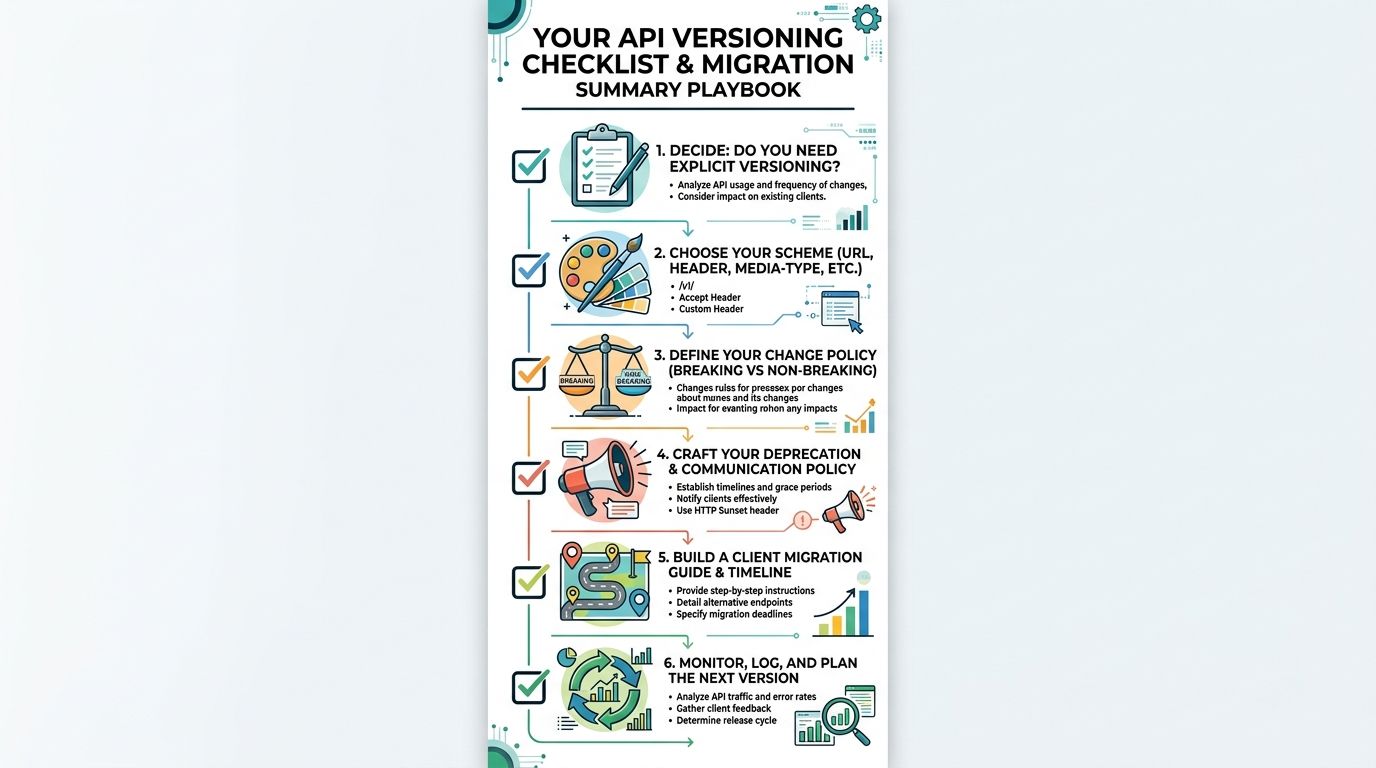
A practical migration playbook looks like this. Announce the change with a clear deprecation window, publish the migration guide, keep both versions active during the overlap, and watch usage until the old version is completely quiet. The migration guide framework should spell out code changes, rollback expectations, and who owns client questions, because migration success is usually won in the documentation and support workflow, not in the release notes.
For a team moving from v1 to v2 over 12 months, the winning pattern is calm and explicit. The release note names the break, the docs show the exact request and response differences, the old version stays supported long enough for real clients to move, and the sunset date only lands after usage has dropped and the remaining consumers have been contacted directly.
If you want versioned APIs and documentation that stay aligned without turning every release into a manual cleanup project, take a look at GitDocAI. It helps teams keep multi-version docs in sync with code changes, which is exactly what version governance needs when v1, v2, and deprecated pages all have to stay accurate at once.